Atrial fibrillation, often abbreviated to AF, is the most common type of cardiac arrhythmia and is a major challenge in medical care. People with atrial fibrillation (AF) are five times more likely to have a stroke.. Atrial fibrillation is a problem that is increasing these days as the population of countries increases. Early detection of AF and proper treatment are very important. There have been many studies on screening methods for patients with AF; Currently, the standard and common method for effective diagnosis of atrial fibrillation is the use of 12-lead ECG.However, the 12-lead electrocardiogram is not a good diagnostic tool for assessing asymptomatic or occasional symptoms because people who do not have symptoms or who sometimes have symptoms of heart problems may not be able to see a doctor at any time for an ECG. Fortunately, with the advancement of technology, devices have been introduced to the market that can detect AF symptoms in an instant before the problem becomes acute.. By connecting to a smartphone, these devices can hold an ECG through the fingers. In this article, we try to examine the effective diagnosis of atrial fibrillation with a new generation of devices connected to a smartphone. Stay with us.

Atrial fibrillation and its diagnosis
Cardiovascular diseases are recognized as the leading cause of death worldwide. In fact, these diseases are the leading cause of death worldwide; About 17.3 million deaths from heart disease are reported worldwide each year, and this number is expected to increase to more than 23.6 million by 2030.Heart disease is a group of diseases that include coronary artery disease (CAD) such as stable angina, unstable angina and myocardial infarction (MI), commonly known as heart attack;High blood pressure, diabetes, smoking, lack of exercise and lack of physical activity, obesity, high blood cholesterol, poor diet and excessive alcohol consumption, etc. greatly increase the risk of coronary heart disease.People who have been diagnosed with cardiovascular disease, as well as people who are at high risk for one or more risk factors - high blood pressure, diabetes, high blood fats, or other underlying diseases - need appropriate treatment. Early diagnosis of the disease.
Atrial fibrillation (AF) is the most common type of cardiac arrhythmia, which is a major challenge in medical care. The disease is associated with a high risk of cardiovascular problems, including sudden death from heart disease, heart failure, ischemic heart disease, and heart attack.
Symptoms of atrial fibrillation usually include palpitations, shortness of breath, weakness, dizziness, fainting, fatigue, and chest pain. It is estimated that about half of patients with atrial fibrillation go undiagnosed because patients often ignore the symptoms of the disease and are unaware of the fact that the symptoms they are experiencing can be a sign of potential heart abnormalities.
Atrial fibrillation can be diagnosed with a pulse, but can sometimes be mistaken for an increased heart rate. Therefore, the diagnosis of symptoms of this disease can only be confirmed using an ECG.
ECG is one of the most widely used methods for measuring heart rate using electronic techniques. Proper blood flow to the heart depends on proper contraction of the heart muscle, which is due to the production and transmission of electrical impulses.This biological electrical activity of the heart can be recorded and analyzed using the signal of an electrocardiogram or ECG device, which is very useful in diagnosing a significant number of cardiac abnormalities.
An ECG test is the best way to diagnose atrial fibrillation disorder; However, ECG testing and ECG interpretation is not a simple and straightforward process that can be performed at home using a standard ECG device, and its interpretation is not possible for people without medical knowledge.
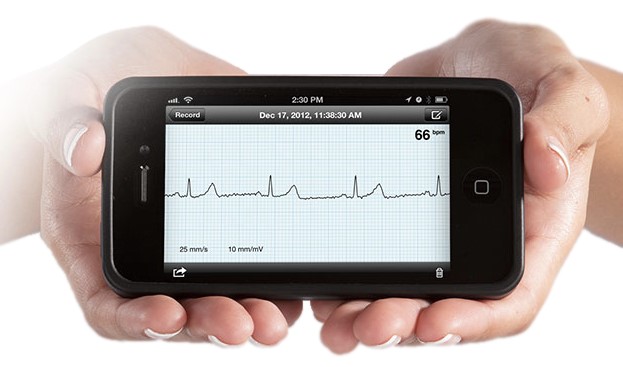
For this reason, researchers have introduced a new generation of ECG devices to effectively diagnose atrial fibrillation, which connects to a smartphone, making it easier to diagnose this heart problem.

Detection of atrial fibrillation with a new generation of ECG devices
As we have said, the process of performing an ECG test and interpreting it by a person who has sufficient knowledge of the ECG is a difficult and impossible task.With extensive research and studies to diagnose atrial fibrillation as soon as possible, devices have been introduced that have a function similar to an ECG device and can obtain an ECG strip by connecting a smartphone and using the fingers. The new device is easily placed on the surface of the body and takes the patient's ECG at the push of a button, anytime, anywhere in seconds.

If the heart rhythm is irregular or a P-wave is not seen on the ECG, there is a risk of AF and the person should see a doctor as soon as possible for a 12-lead ECG and a follow-up diagnosis. This device is designed to be highly sensitive and accurate so that it can help reduce the risks of AF disease by correctly and timely diagnosis.
Evaluation of the effectiveness of atrial fibrillation diagnosis with new ECG devices
To find out how effective atrial fibrillation detection is with a new generation of smartphone-connected devices, a team of researchers in the UK conducted a study on one of these models of new ECG devices. In the experiment, the following factors were considered to measure accuracy:
• The sensitivity of the device and its accuracy and success in diagnosing AF disease in patients who participated in this experiment.
• Features and success rate of this device in diagnosing the health of people without AF who participated in this test.
• The degree of validity of the AF lack diagnosis by the device and the physician's confidence in the negative result reported by the device.

The study that was performed on the performance of this device was independent of the manufacturer of this device and the selection of the people under study was the responsibility of the researchers. For this study, 29 patients with AF were selected from patients with a history and a number of others with other diseases.First, a 12-lead ECG was taken from both groups of patients, which included 99 patients, and at the same time, a ECG was taken for 30 seconds using a new ECG device connected to a smartphone. A general practitioner and a cardiologist then began to examine the ECGs independently and were asked to determine which ECG belonged to the 12-lead device and which to the new ECG. Of the 99 ECGs taken from the subjects, 4 ECGs were illegible and discarded. The results of this study are shown in the table below.
People with AF according to the results of the 12-lead ECG test |
People without AF according to the result of the 12-lead ECG test |
|
|
Results announced by the general practitioner |
||
|
26 |
9 |
Has AF based on the ECG of the new device connected to the smartphone |
|
3 |
57 |
No AF based on the ECG of the new device connected to the smartphone |
|
90% sensitivity |
Feature 86% |
|
|
Results announced by a cardiologist |
||
|
27 |
16 |
Has AF based on the ECG of the new device connected to the smartphone |
|
2 |
50 |
No AF based on the ECG of the new device connected to the smartphone |
|
Sensitivity 93% |
Feature 76% |
|
According to the results shown in the table, the researchers found that the new generation of ECG devices connected to a smartphone, due to its high sensitivity, convenient features and reliable reliability, can be used to detect the lack of AF.. The researchers recommended that if the electrocardiogram of these new devices was interpreted by the treatment staff, it could be used for the initial diagnosis of atrial fibrillation and screening for the disease. The researchers said that the predictor of AF deficiency depends on the prevalence of the disease; The effectiveness of diagnosing atrial fibrillation with a new generation of devices connected to a smartphone depends on the prevalence of the disease, and in elderly populations with a high prevalence of AF, the device will be more effective in the initial diagnosis.
Heart disease is the leading cause of death in various societies.Diagnosis and treatment of heart disease was difficult until a few years ago, and many heart patients were unaware of the problem and its symptoms.One of the most common heart diseases is atrial fibrillation or AF, which is easy to diagnose with a 12-lead ECG test, but it is not always easy for patients to access.In this article, we found that the new generation of smartphone-based ECG devices that are installed on the patient's body and are highly sensitive in diagnosing the disease, can play an effective role in early diagnosis of the disease. The predictive validity of the absence of atrial fibrillation with the new generation of ECG devices connected to a smartphone is high and can be considered a reliable method for screening the population with AF.
.png)


